Valentin Simanov
Tabby Card

From in-store BNPL solution to a credit card experience

Staying under BNPL rules.

USD 30M → USD 300M

10× monthly GMV growth after key changes shipped, January 2025 onwards

#1 card issuer in the UAE

By issuance pace, H1 2025, per Visa

My Role: owned the UX, working from regulatory constraints to shipped interfaces

Context

Before, Tabby Card was BNPL for in-store purchases

A tokenised card in Apple Wallet, but the user still had to ask for a limit before every purchase.

The brief: make it work everywhere, on one pre-approved limit.

Given: two decisions by the business
Old card: BNPL logicWhat it cost the userDecided by the business
Partner stores onlyA card in the wallet gets tapped everywhere. Outside the network it declined.Works everywhere
A limit requested for each purchaseAn extra step before every payment, and no way to know in advance whether it goes through.One pre-approved limit
Also given: the BNPL rules that stayed
AED 20,000

Total BNPL limit per person

12 months

To repay every purchase

30%

Cap on total fees per purchase

1 tap = 1 loan

Every transaction is a separate BNPL loan

The opening
No income check

No confirmed-income requirement

Key UX shifts

From BNPL logic to the mental model of a credit card

Three questions every cardholder asks, and how the answer changed.

What can I spend

Approved upfront

A pre-approved limit for any merchant, known before the purchase.
Before
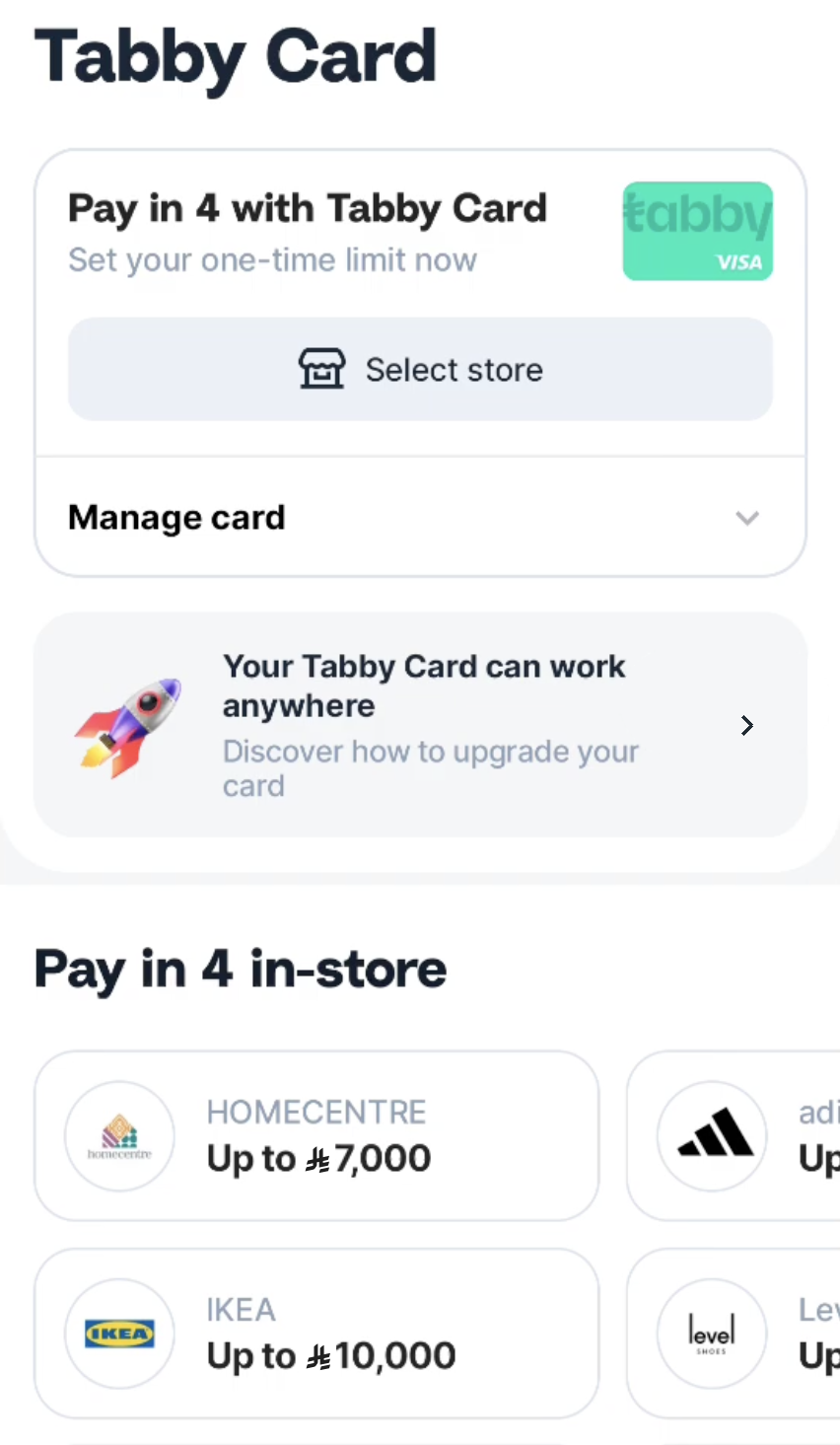
Before: Pay in 4 with Tabby Card, set your one-time limit now, Select store

A one-time limit, requested per store before each purchase.
After
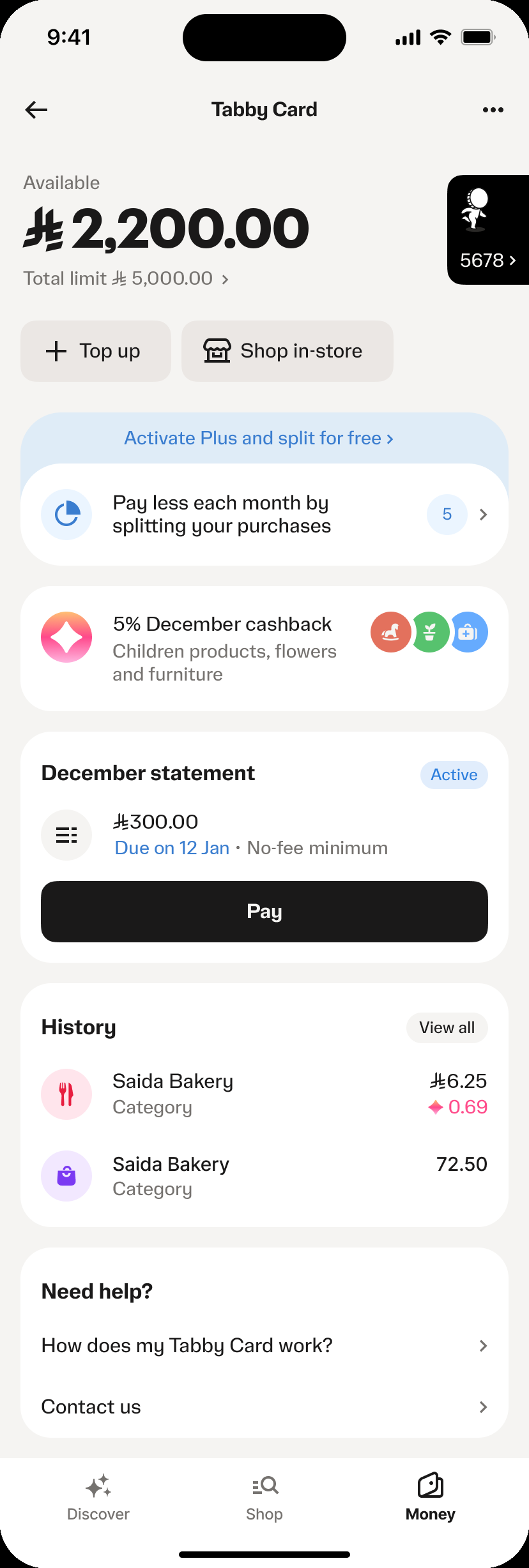
After: card screen, 2,200.00 available, total limit 5,000.00

AED 2,200.00 of AED 5,000.00 available, at any merchant.

What do I owe

Billed once

All purchases on one statement, one due date.
Before
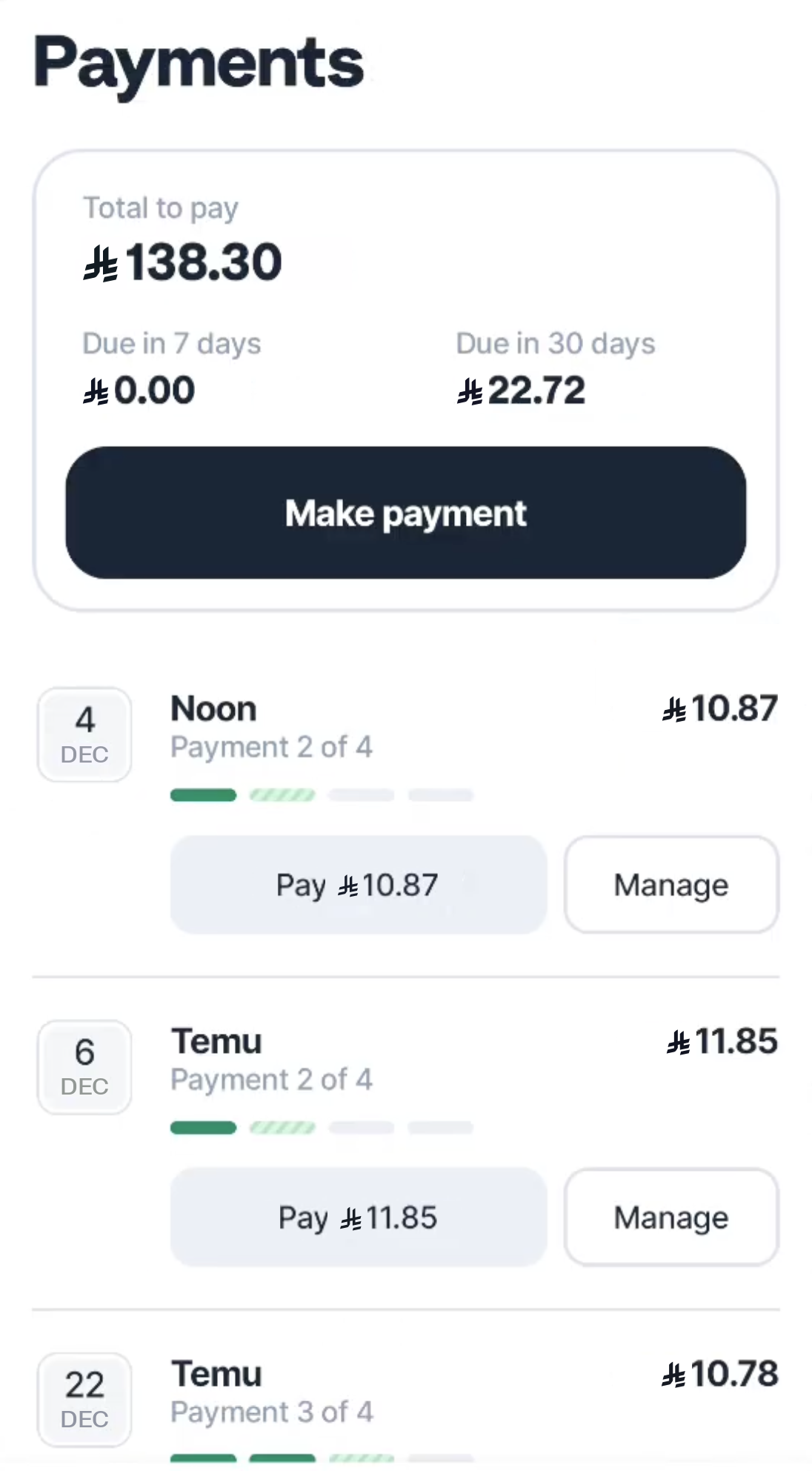
Before: Noon and Temu purchases, each with its own schedule and Pay button

Every purchase with its own schedule and its own Pay button.

After
After: card screen with the December statement widget in focus, 300.00 due on 12 January, no-fee minimum, one Pay button

One statement for December. AED 300.00 due on 12 January, one Pay button.

How do I pay

Paid your way

Any amount from the minimum to the full balance, with the consequence shown before you pay.
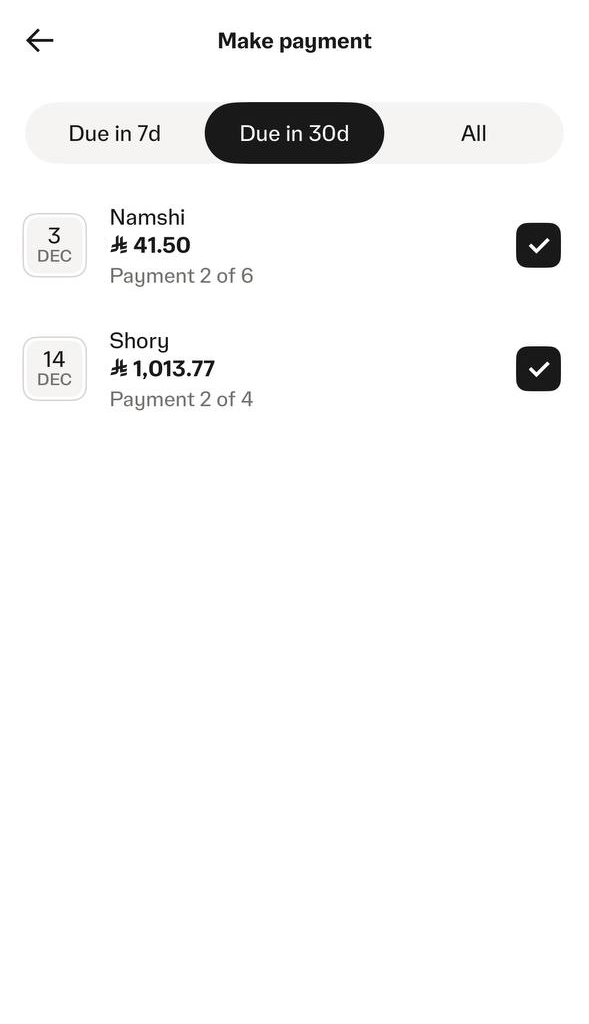
Before
Before: Make payment, instalments due in 7 or 30 days ticked one by one

Instalments ticked one by one.

After
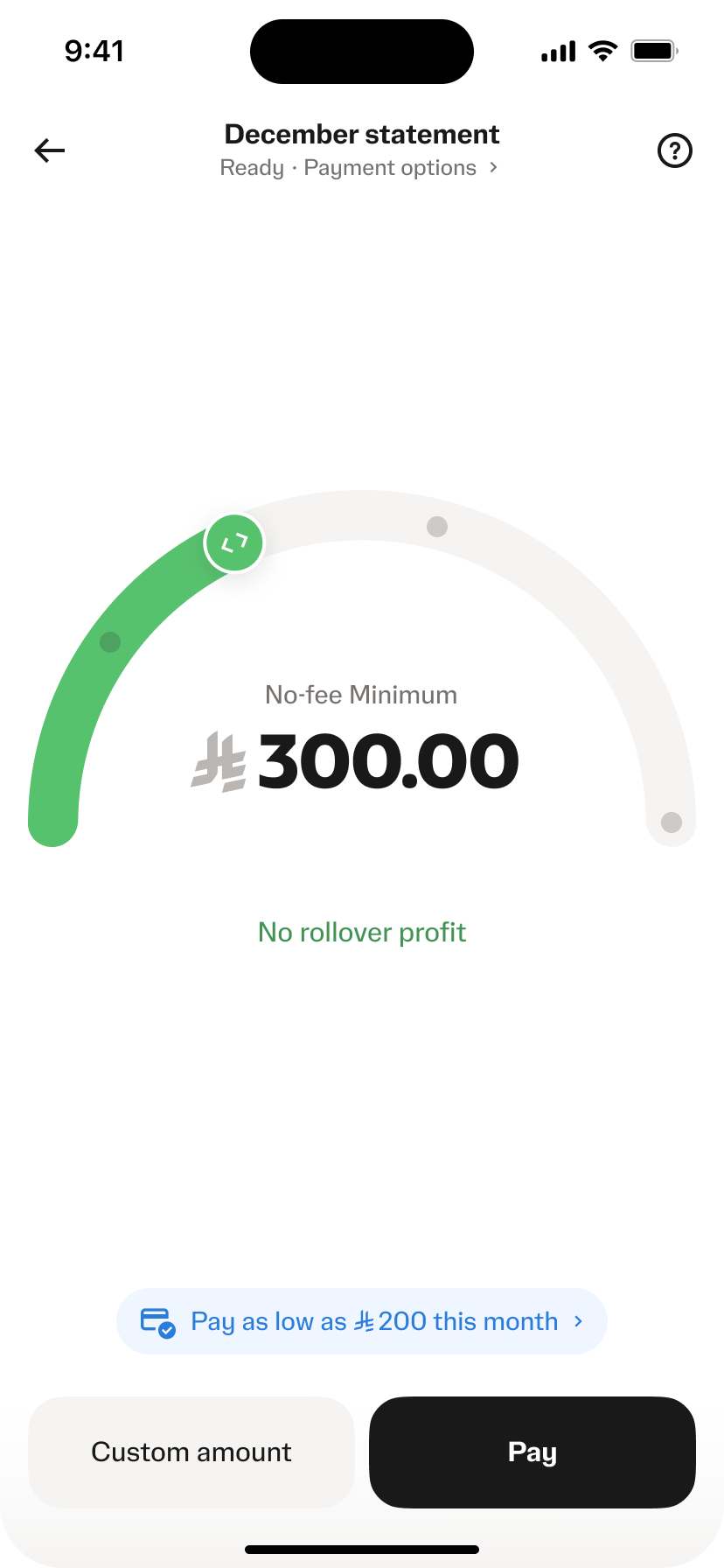
After: payment wheel at No-fee Minimum 300.00, no rollover profit

Pick an amount on the wheel and see what it means: a fee, no fee, or the balance cleared.

“Before” screens are reconstructed from a public review.

Takeaway

A credit card in the user’s head. A limit on BNPL transactions underneath.

What it gave users

A clear credit limit turned out to be the main value for people banks would not underwrite for a credit card, often because of minimum-income requirements. We could, because it is a limit on BNPL transactions, not a credit card.

Next · Deep dive

The devil is in the details. The next part shows how repayment, the most sensitive flow, stayed easy to think about.

Deep dive · Repayment

One statement, a different benefit on every purchase

A benefit is the right to spread a purchase over several months. Which one applies depends on where the purchase was made and what the customer has switched on. It also decides the least they can pay for that purchase this month.

Given: four types of purchase on one card
The purchaseIts benefitDue this month
Partner storeSplit in 4 monthly payments, no fee1/4 of the price
Any store, with a subscriptionSplit in 4 monthly payments, no fee1/4 of the price
Other store, no subscriptionNoneAll of it
Any purchase, split manually6, 8 or 10 monthly payments, for a feeOne fixed instalment. It lands in the monthly statement with everything else.

The brief: fit all of them into one repayment flow, and add a minimum payment, as on a real credit card.

Minimum payment: 10% of any purchase now, for a rollover fee. The rest moves to future periods.

What the customer asks on the due date

“How much do I pay now, and what does it cost if I pay less?”

By then everything sits in one balance, and the least you can pay without a fee is a different share of every purchase.

The answer is a range with four named points

Every amount between them is allowed. What changes along the way is the consequence.

Smallest paymentLargest payment
Fee applies
Minimum

10% of every purchase. A rollover fee applies and the rest moves to future periods.

No fee
No-fee minimum

The sum of what each purchase’s benefit asks for this month. The least you can pay without a fee.

No fee
Statement

Everything on this month’s statement, paid in full.

No fee
Full balance

Everything owed, future instalments included. The balance cleared.

Standard approaches, and where each one breaks

BNPL checklistThe screen we were leaving. Fine at 4 purchases a month, unmanageable at 20.
Amount fieldType, then retype to see a consequence. No bounds, no hints.
Credit card listMinimum, no-fee minimum, statement, full balance, custom amount. Five options for what is really a range, and it gets messy once each one has to explain its consequence in every state.

So the whole range became a wheel

Every point on it shows what paying that amount leads to. The four named points are stops along the way.

Try it · drag the handle
What some customers ask next

“Where does this amount come from?”

The wheel says how much. Nobody has to do the math to pay, but anyone who wants to check a number can open the statement and trace it down to a single purchase.

1Pick an amountMinimum, no-fee minimum or statement.
2See what it is made ofInstalments, partner stores, non-partner stores.
3Open any partEach purchase, and the benefit applied to it.
Try it · tap an amount or a row
Takeaway · Repayment

One number to pay, one gesture to change it, every amount traceable to a purchase.

The customer sees a credit card. The BNPL rules stay underneath.

Figma Every state of the repayment flow
Download Figma file

Figures in the prototypes are illustrative.

Conclusion

Why the card grew

Monthly GMV grew 10×. Two things made that possible.

FrequencyA huge BNPL base, moved to a daily spending product

Tabby already had the users. The card took them from occasional BNPL purchases to paying with Tabby every day.

AccessA credit card for people who could not get one

Income requirements, or simply not being eligible at a bank, kept them out. A limit on BNPL transactions let them in.

Beyond repayment: what else I worked on
The real growth driverLimits and eligibility

Growth only works while credit loss stays in check, so limits move both ways. The UX explains every change well enough to keep contact rates low, under one shared AED 20,000 ceiling.

New for the organisationDisputes, refunds, declines

Complex card cases the company had not handled before.

Paid add-onsLong plans

Splitting a purchase into 6, 8 or 10 payments for a fee, and how to grow it.

Personal note

For most of our cardholders, this was the first credit card they ever had, in everything but name.

We heard that from them directly. I heard it in less expected places too. I would hand over my documents at a government office, someone would notice I worked at Tabby, and they would thank me for the card. I am proud of that to this day.